
- Origin: Memphis (Shelby County)
- Active: Nashville (Davidson County)
- Region: Middle
- Mediums: Tattooing, Painting, Wearable art, Fiber/Textile
- Website | Instagram | Facebook
Elisheba Israel Mrozik
“The narrative of Black identity has, for too long, been interwoven with threads of deception, appropriation, and commodification. Nowhere is this more evident than in the complex journey of Ankara fabric, a textile that many view as emblematic of African heritage. But as the ‘Hood Cloth’ series seeks to illuminate, the true story of Ankara is far from African; it is a tale of cultural theft and marketing subterfuge.
That this fabric was then marketed as distinctly African, and embraced as such, adds layers of irony and pain to its history. The ‘Hood Cloth’ series emerges from this backdrop as an earnest attempt to challenge and counteract the misrepresentations surrounding Ankara. This series isn’t just an exploration of textiles and designs; it’s a call to peel back the layers, to question the authenticity of symbols that have been handed to us, and to reclaim our narrative from the clutches of colonial commodification.
To truly craft Blackness, it is imperative to return to the genuine roots of our culture. This is the spirit in which ‘Hood Cloth’ has been conceived. I craved the ritual- something wholly Black, undiluted. By adopting the traditional Malian mudcloth crafting process, untouched by colonial or commercial influences, there’s an embrace of a history that is truly African. Kola Nuts from Ghana- to pay homage to our ancestors- manually grinding them on a primitive mortar and pestle into a fine powder for dyeing. Gathering mud from the very alleys of North Nashville, sifting out the grass and glass, the creation process of each ‘Hood Cloth’ piece becomes a ritual – one of reconnection, remembrance, and resistance.
‘Hood cloth’, for me, has been about defining black American culture untainted. In a world where the lines between genuine cultural expression and commercial exploitation are often blurred, ‘Hood Cloth’ stands as a beacon of authenticity. It is not merely a reactionary statement against the false narratives of Ankara but a proactive step towards redefining Black identity on our terms. In the ‘Hood Cloth’ series, each piece is an assertion, a reminder that the power to define Blackness lies within us. It urges us to look beyond the facades, to question the origins of the symbols we embrace, and to craft our identity from a place of knowledge, pride, and truth.
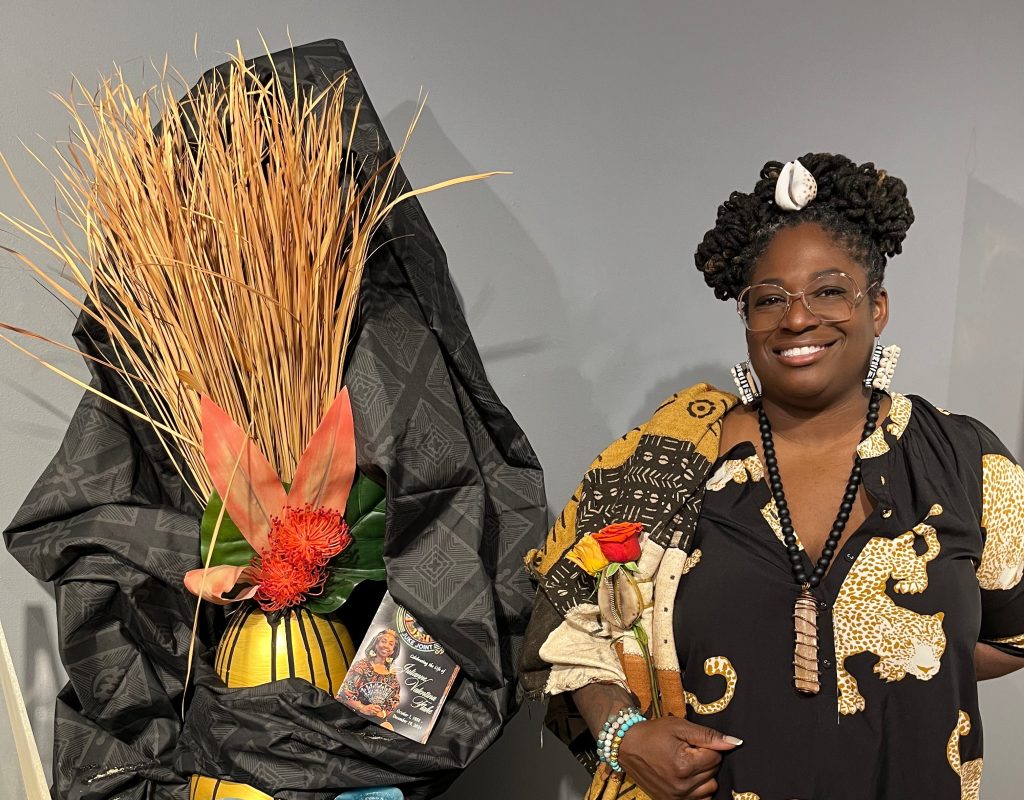
“Altars to my Matriarchs Series” – In the tapestry of existence, there are threads that often remain hidden, obscured by the trials and tribulations of history. My series, ‘Altars to my Matriarchs’, is a homage to these very threads, a tangible bridge to my ancestral lineage that stretches back through centuries, encompassing both pain and perseverance. As I look into the mirror each day, I see not just myself, but the reflections of a lineage of strong black women who withstood the onslaught of adversity, from the brutalities of enslavement to the harshness of Jim Crow. It’s a reflection of my mother, my grandmother, and all the matriarchs who preceded them. These altars are more than just artistic expressions; they are spiritual ties binding me to these incredible women who survived and thrived against all odds, ensuring that the baton of life passed down generations, culminating in my existence today. In ‘They Itch’, I present an homage to my Great Great Great Grandmother, Nancy Hanks. Born enslaved, she bore the literal scars of her time, scars that told stories of suffering and resilience. Through the rich amalgamation of materials – candle wax, glass, shells, lavender, fabrics, magnolia, and other mixed media – I try to capture the essence of a woman who lived a life of immense hardship. From a conversation with my Aunt: ‘Yeah, My Grandma Nancy, would have a real bad itch on these long whip marks in the center where she couldn’t quite reach. She‘d say “Come here chile! Scratch right ‘chere. They itching bad today.” I’d go up and scratch those whip marks. They were raised something awful and went in all directions. I didn’t ask why she got em. It didn’t matter” The haunting memories of her whip marks, described so vividly by my aunt, remind me that our collective history is still very much alive in our family’s oral traditions.
These altars are not just inanimate objects; they are living stories, echoes of time that resonate with love, respect, and reverence. It’s a journey through the lives of women who laughed, loved, suffered, and triumphed. They may belong to my personal history, but their stories are universal, representing countless unsung heroines who, in their unique ways, shaped the world we inhabit today.
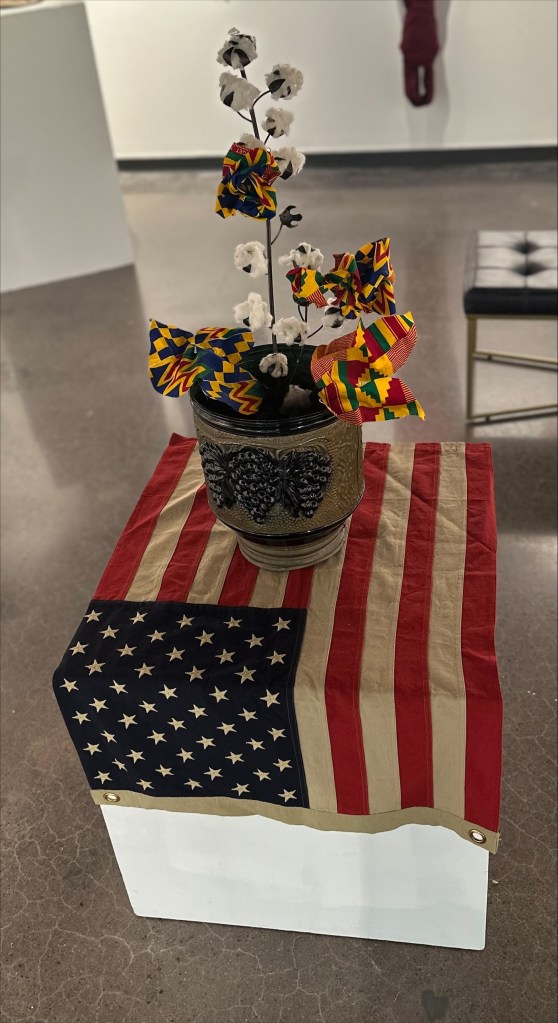
Drawing from my diverse artistic pursuits and deep connection with Tennessee, the ‘Cash Crop’ series delves into a profound and often painful history associated with cotton. This wonder crop, which led the United States to the pinnacles of global prosperity, bears with it a weighty history of forced labor, displacement, and cultural detachment of innumerable souls of African descent. As a multidisciplinary artist, my journey has always oscillated between local roots and global platforms, and with this series, I am attempting to bring forth the juxtaposition of agony and growth – an ode to the perseverance of the Black spirit. ‘Field’ embodies the fullness and vigor of the cotton plant just before it is harvested. Here, the amalgamation of materials – the American Flag, metal urn, Acrylic, Tennessee soil, Ankhara Fabric, wire, steel, and cotton – tells the story of transformation and endurance. Each material is a testament to the various layers and intricacies of the Black experience.
AT the same time as the cotton plant bloomed, Black Culture bloomed. The spirituals sung to help endure the harsh working conditions and even harsher living conditions were the birth of all popular music today. The style we created from scraps given by masters, began to form- the inspiration for all popular fashion today. Field sits atop an American flag, sprinkled in dirt, for its is not a flag of honor and would be nothing without those in the field who did the work.”
Elisheba Israel Mrozik is a Fine Artist and International Award Winning Tattooist. She graduated from Memphis College of Art in 2006 with a BFA in Computer Arts. After moving to Nashville, TN in 2007, she began to work full time as a freelance artist in graphic design, anime, and fine art. Elisheba was a part of Nashville Black Artists Renaissance, and has shown at Columbia State, The Ha Factory, Boheme Collectif, Corvidae Gallery, and other venues. She was a New York Comic Con artist in 2010 and has created live murals at events with the Goo Goo Dolls in Buffalo, NY. Additionally, Elisheba has also been in various music videos and commercials like Old Dominion, Budweiser, and Yelawolf. Her work is currently on display at the Frist Art Museum in Nashville. Late 2010, she became interested in tattooing after viewing work by some world renowned artists.
Elisheba is now an Award Wining Tattoo Artist in many categories, Indieville TV’s 2015 Nashville Tattoo Artist of the Year and was an artist on the international TV show Inkmaster. She released her first coloring book titled Notable Nashville about historic marginalized people of Nashville in 2017 and is releasing her second book- Sovereign Goddess- a collection of her drawings. Elisheba specializes in realism, watercolor and illustrative realism. Her goals are to travel the world and create art with her family. She prides herself on working diligently to create art and art spaces for disenfranchised peoples, being a loving mother and devoted wife, every day.
Source: https://www.queenbeeink.com/
 CRAFTING BLACKNESS
Leave a comment